Encourage people and teams with different areas of expertise to work together toward a common goal.
Cross functional cooperation is a group of people with different technical expertise who work together towards a common goal. Each will focus on their area of expertise but share knowledge and resources to facilitate and expedite the successful team goal.Many project management teams are cross functional including people from finance, operations, marketing, HR and IT in order to tackle a complex overarching goal.
More companies are encouraging cross functional collaboration and even structuring their businesses around cross-functional teams. Previously functions were run in silos. Now, with the need for businesses to be agile and make strategic decisions in a complex environment, the requirement for employees to communicate and collaborate to assist in the smooth integration of new systems and processes has become imperative. Furthermore, cross functional cooperation is recommended as a way of managing and preempting conflict that may arise due to change.
When individuals with diverse workstyles and functions come together the results can be innovative and trans-formative. Research shows however that despite its positive effects, many cross functional teams are dysfunctional. It is imperative that a clear hierarchy is defined and the rules of engagement and communication are understood by all. Leaders must have a clear understanding the difference between cooperation and collaboration. A culture of sharing needs to be created by putting aside time for collaboration to take place through scheduled meetings so that individuals learn to do it well and see it as a norm, realising its value. Encourage sharing of stories - both successes and setbacks with transparency. Avoid information hording by establishing a dedicated knowledge sharing platform that encourages the documentation of both informal and formal ideas into a referential knowledge base.
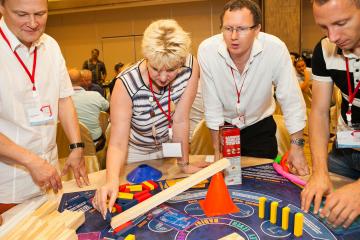
Experiential business games and team building activities which focus on cross functional collaboration can assist greatly as a metaphor for cooperative work practises. Team building exercises that encourage team bonding and networking can also play a vital role in breaking down silos.
Look at this selection of related popular programs. Need help in deciding? Looking for something else?